3 Best Budget Gaming Desktops and Why a Tower Beats a Laptop in 2026
As an Amazon Associate, this website earns from qualifying purchases.
The short answer
A budget gaming desktop gives you more graphics power than a laptop at the same spend, and you can upgrade it one part at a time. Pick a tower with standard parts, a named power supply and room for a bigger graphics card, such as an RTX 5060 system from a known builder.
If you want the most gaming performance for the least money, a budget gaming desktop is still the answer. A tower has room for a full-power graphics card, proper cooling and a power supply that can grow with you. A laptop at the same price has to fit all of that into a thin case running on a battery.
Short answer: a budget gaming desktop beats a laptop on performance per dollar and on upgrades. Look for an RTX 5060 or Radeon RX 9060 tower with standard parts, 16GB of memory and a named power supply.
Keep in mind: the Core i5 is fine for gaming but not the fastest for heavy creative work.
Product details checked September 2026
At the top of the budget range, MSI's Codex R2 pairs an RTX 5070 with 12GB of video memory, a Core i5-14400F and 32GB of DDR5. MSI says it uses standard parts, so storage, memory and GPU upgrades are straightforward. It uses a four-fan airflow layout and Wi-Fi 6E.
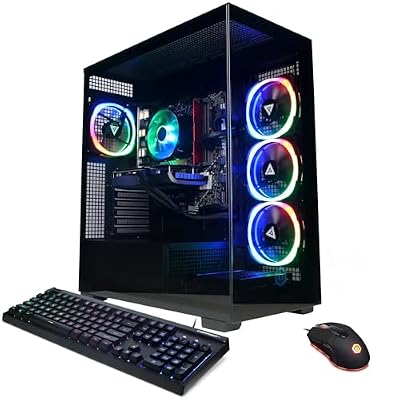
#2. CyberPowerPC Gamer Master (RTX 5060): Best value
Keep in mind: check the listed power supply before planning a bigger GPU upgrade.
Product details checked September 2026
For a lower budget, the Gamer Master pairs an RTX 5060 with a Ryzen 5 8400F, 16GB of DDR5 and a 1TB PCIe 4.0 SSD. The DDR5 platform leaves room for a faster processor later.
#3. Skytech Gaming PC (RTX 3050): Best for the tightest budget
Keep in mind: an older platform and entry GPU, so new games need low settings.
Product details checked September 2026
At the entry level, Skytech's Ryzen 5 5500 system pairs a 6GB RTX 3050 with 16GB of DDR4 and a 1TB SSD, in a mesh-front case. It is a sensible start if you plan to upgrade the GPU later.
Factors to consider when choosing a budget gaming desktop
A budget desktop is often the start of a system you improve over time. These details decide how far you can take it:
Power supply. A named unit with some spare wattage lets you fit a bigger GPU later. A bare-minimum supply limits you to cards of similar power.
Case size. A mid-tower has room for longer graphics cards. Small cases can block larger cards.
Motherboard platform. Newer platforms, such as those that use DDR5 memory, usually offer a better path to faster processors.
Memory slots. Free slots let you add memory without replacing what you have.
Standard parts. Some big-brand towers use custom motherboards or power supplies that are hard to replace. Builders like MSI say their systems use standard, off-the-shelf parts.
Why a Desktop Beats a Laptop on a Budget
Full-power graphics. A desktop GPU runs at its full power limit. Laptop GPUs with similar names usually run at lower limits to control heat, so they deliver less. Our gaming laptop vs desktop comparison explains the gap in detail.
Better cooling. A tower has space for large fans and heatsinks. Parts run cooler and quieter. They also hold their speed in long sessions.
Upgrades. You can swap the graphics card, add memory or add a drive, one part at a time. Most laptops only let you change memory and storage, and some not even that.
Repairs. If a part fails, you replace that part. A failed laptop part often means sending the whole machine away.
The trade-off: a desktop needs a monitor and accessories, and it stays on the desk.
Plan for the Rest of the Setup
A desktop needs a monitor and accessories. If you don't own them, set aside part of your budget. A 1080p monitor at 144Hz or faster is the natural match for an RTX 5060. Our best budget gaming rig guide explains how to split a budget across the whole setup.
Where to Put a Budget Gaming Desktop
Place the tower where air can reach its intake. On the desk or on a hard floor works well. Avoid thick carpet and closed cabinets, which trap heat and dust. Keep a few inches of space behind the case for the exhaust, and make sure you can reach the front ports for a headset or controller.
Keep the Desktop Quiet
Budget desktops can get loud under load. A few free steps help. Keep dust filters clean. Leave space around the case. Use the fan curve settings in the BIOS or the maker's app to slow the fans at light loads.
Verdict: Is a Budget Gaming Desktop Right for You?
If you play at a desk, a budget gaming desktop is the better buy. It gives you more graphics power than a laptop at the same spend, and you can upgrade it one part at a time. Choose an RTX 5060 tower like the CyberPowerPC Gamer Master for value, or the MSI Codex R2 if your budget stretches to an RTX 5070. Check the power supply, case size and platform so the desktop can grow with you.
FAQ
Is a budget gaming desktop better than a gaming laptop?
For raw performance per dollar, yes. A desktop graphics card runs at full power without the heat and battery limits of a laptop. A laptop is only the better choice if you need to carry it.
Can I upgrade a budget gaming desktop later?
Usually. Most towers from known builders use standard motherboards, memory and storage. The graphics card is the most common upgrade. Check the power supply wattage and the case's GPU clearance before you buy a bigger card.
What else do I need to buy with a budget gaming desktop?
A monitor, keyboard, mouse and headset, if you don't already have them. Some desktops include a basic keyboard and mouse. Our budget gaming rig guide covers how to split a budget across the whole setup.