6 Best Laptops for Programming and How to Choose One in 2026
As an Amazon Associate, this website earns from qualifying purchases.
The short answer
The best laptop for programming for most developers is a MacBook Air with an M-series chip and 16GB of memory, which pairs long battery life with a sharp screen. Choose a ThinkPad T14 Gen 6 with 32GB if you work on Windows or Linux and run containers, and a laptop with an NVIDIA GPU, like the Lenovo LOQ 15, if you do game development or CUDA work.
The best laptop for programming is the one that stays out of your way: fast enough that builds don't stall, with enough memory for your tools, a screen that shows a lot of code, and a keyboard you enjoy for hours. The right pick depends on what you build and which operating system your tools need.
Short answer: most developers should buy a MacBook Air with an M-series chip and 16GB of memory. Choose a ThinkPad T14 Gen 6 with 32GB for Windows or Linux work with containers, and a laptop with an NVIDIA GPU for game development or CUDA.
This hub covers programming laptops: our picks first, then how to choose one for the kind of code you write.
WSL, Microsoft's Windows Subsystem for Linux, lets you run Linux tools on a Windows laptop.
We chose these from current US listings and each maker's published specs. We did not test them by hand.
#1. Apple MacBook Air 13 (M4): Best for Most Developers
Keep in mind: 256GB of storage fills quickly and cannot be upgraded later.
Product details checked September 2026
The M4 MacBook Air comes with 16GB of unified memory, a 13.6-inch Liquid Retina display and Apple's rating of up to 18 hours of battery life. It has two Thunderbolt 4 ports, MagSafe charging and Wi-Fi 6E, and supports up to two external displays. The base 256GB of storage is tight for developers, so consider a larger configuration if you can.
Keep in mind: macOS does not run some engineering and Windows-only course software.
Product details checked September 2026
The M5 MacBook Air keeps the same thin design with the newer M5 chip, 16GB of memory and 512GB of storage, which suits development better than 256GB. It adds Wi-Fi 7 and Bluetooth 6 through Apple's N1 wireless chip.
#3. Apple MacBook Pro 14 (M5): Best Mac for Heavy Builds
Keep in mind: 16GB of memory is fixed, so heavy multitaskers should look at the M5 Pro.
Product details checked September 2026
The 14-inch MacBook Pro with M5 has a 10-core CPU and 10-core GPU, 16GB of unified memory, and a bright 14.2-inch Liquid Retina XDR display. It suits developers with large builds who also want a brighter, better screen.
Keep in mind: integrated graphics only, so no GPU work or modern gaming.
Product details checked September 2026
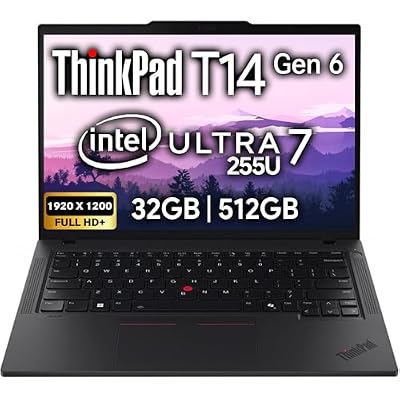
The ThinkPad T14 Gen 6 pairs an Intel Core Ultra 7 255U with 32GB of DDR5 and a 512GB SSD. It has a 14-inch 1920 x 1200 anti-glare screen, two Thunderbolt 4 ports, HDMI and wired Ethernet, and supports up to three external monitors. It meets MIL-STD-810H test standards and ships with Windows 11 Pro.
Keep in mind: no dedicated gaming GPU and 16GB of memory is fixed for heavy work.
Product details checked September 2026
The XPS 14 pairs a 16-core Intel Core Ultra 7 255H with 16GB of LPDDR5X and a 1TB SSD. Its 14.5-inch 3200 x 2000 OLED touchscreen is very sharp for its size, and it has three Thunderbolt 4 ports and Wi-Fi 7. The memory is soldered, so choose 16GB knowing you can't add more.
#6. Lenovo LOQ 15 (RTX 5060): Best for Game Development and CUDA
Keep in mind: a plain design and a 512GB drive that fills quickly.
Product details checked September 2026
If you build games or train models locally, you need a real GPU. The LOQ 15 pairs an RTX 5060 with a Ryzen 7 250 and 16GB of DDR5 you can expand to 32GB. It is heavier and has shorter battery life than a thin laptop, but it runs game engines and CUDA workloads that thin laptops can't. See our best gaming laptop guide for more GPU laptops.
Factors to consider when choosing a laptop for programming
Memory first. Your editor, browser, terminals and any containers all share memory. 16GB is the minimum. 32GB is worth it for Docker, virtual machines, emulators or data work. Docker Desktop's requirements are a useful reference if you run containers on Windows.
Processor second. Any current mid-range chip compiles code quickly. More cores help with large builds and test suites.
Storage. 512GB is the floor. Toolchains, SDKs, containers and project folders add up fast, so 1TB is safer.
Screen. More pixels show more code. Look for 1920 x 1200 or sharper, ideally with a taller 16:10 shape. A matte or anti-glare panel is easier on the eyes over long sessions.
Keyboard. You will type all day. Comfortable key travel and a sensible layout matter more than most specs.
Ports. Thunderbolt or USB-C with display output lets you connect external monitors, which most developers use at a desk.
Battery. A laptop that lasts a full day unplugged makes working from anywhere easy.
Set up a package manager, such as Homebrew on macOS or winget on Windows.
On Windows, enable WSL if you work with Linux tools.
Use an external monitor at your desk. Most developers find a second screen the single biggest productivity upgrade.
More in this guide
Every guide in this section:
Verdict: The Best Laptop for Programming
The best laptop for programming for most developers is a MacBook Air with 16GB of memory. The M5 model's 512GB of storage suits development better than the M4's base 256GB. Choose the MacBook Pro 14 for heavy builds, the ThinkPad T14 Gen 6 with 32GB for Windows and Linux work, and the Lenovo LOQ 15 if you need an NVIDIA GPU for game development or CUDA. Students choosing a laptop for a computer science degree should also read our best laptops for engineering students guide.
FAQ
How much RAM do I need for programming?
16GB is enough for most web and app development. Choose 32GB if you run Docker containers, virtual machines, Android emulators or large data sets alongside your editor and browser.
Is a MacBook good for programming?
Yes, for most developers. macOS is Unix-based, so command-line tools work much like they do on Linux servers, and a Mac is required for building iOS and macOS apps with Xcode. Choose Windows or Linux instead if your work depends on Windows-only tools or NVIDIA CUDA.
Do I need a dedicated GPU for programming?
Not for most coding. You do need one for game development, 3D work, or training machine learning models locally with CUDA, which requires an NVIDIA GPU.
Is a gaming laptop good for programming?
It can be, especially for game development or GPU computing. The trade-offs are weight and battery life. For everyday coding, a thin laptop with a good keyboard and screen is more comfortable.